Showing posts with label comparisons. Show all posts

Friday, 30 September 2011

HONDA BRIO VS MARUTI SWIFT 2011


HONDA BRIO VS MARUTI SWIFT 2011

Honda is all set to make a fresh entry in the Indian hatchback market and that too with the best – a small car christened Honda Brio.The Brio is the smallest car from Honda stable and though it has a Honda badge to support it , it sure faces tough competition from the pre-existing competitors like Maruti Suzuki Swift
 Brio has simply outstanding crease on its body and a stunning forward inclined stance to woo. This styling is something that is expected to drive car buyers crazy and it will also help increase its demand exponentially in the country. Honda will bring Honda Brio in striking color options.
Honda Brio will be powered by 1.2 litre engine that currently also powers Honda Jazz. This same engine is expected to get a 1 litre motor in the near future as well. The wonderful car will have a displacement of 1198 cc which is one of the best in terms of engine in the hatchback segment. The engine used in Honda Brio runs will run on petrol and is expected to give a peak power of 90 PS at 6000 rpm and beating torque of 110 Nm at 4800 rpm.


The interior style of Honda Brio is designed such a way which make you to sense relax. Compare to other similar hatchbacks in India, Honda Brio will be at top as per as comfort is concerned. The features like power steering, elegant Dashing board, armrests, gear Knob, body colored mirrors, inbuilt Audio System including USB, Air condition adds much more comfort even in the long journeys with good fuel efficiency.
The Honda Brio features contemporary beige color interiors that most Indians will love although beige is a bitch to maintain especially in the dusty Indian conditions. This color endows the Brio’s cabin with a airy appeal that in typical Honda standards, feels high quality.
Honda Brio comes with three variants and even the base version of the Brio gets ABS as standard piece of kit. Talking of which, the Brio will be available E, S and V variants where E is the base variant.
Pros : Honda refinement, Power, Design, all variants get ABS and airbags
Cons : No Diesel option yet
Pricing :
HondaBrioE –Rs 3.95 lakh
Honda Brio S – Rs 4.35 lakh
Honda Brio S Option – Rs 4.9 lakh
Honda Brio V – Rs 5.1 lakh

new maruti suzuki swift

The new Swift looks so much like the old Swift that it takes only a well-versed eye to spot the differences. Suzuki thought not to fiddle around much with a winning formula and sought only to take care of the most glaring drawbacks that came through user and buyer feedback.
Thus the essential style of the car remains the same but there are a few crucial changes. Both the headlamps and the tail cluster are much larger, with both being wrap-around and the headlamps upswept design giving the Swift an even more distinctive look.
Where the engines of the new petrol and diesel versions are concerned, the new Swift retains the engines from the outgoing Swift model. However with Variable Valve Timing now on the 1197cc petrol engine, it manages to generate 87PS @ 6000 rpm and a decent torque of 114Nm at 4000 rpm.
The 1248cc DDiS diesel mill remains the same and offers a stellar 75PS @ 4000 rpm and a more than decent torque of 190Nm @ 2000 rpm. Both versions are mated to 5 speed gearboxes
Though it doesnt have a very drastic change compared to its predecessor has longer frame and the new headlights and taillights that flutter a stretched look, but also its interiors have received a applause worthy upgrade with features that include a CD player, USB port connectivity, steering mounted controls and an in dash multi information display (MID), all of which presents itself with a far more upmarket feel.
Pros : Bit short on Space compared to Liva, Fuel efficient, Comfort
Cons : Less Boot Space, Priced a bit high for the top end variant.
Pricing :
Lxi – 4.22 lakhs
Vxi - 4.76 lakhs
Zxi – 5.53 lakhs
Ldi – 5.17 lakhs
Vdi - 5.61 lakhs
Zdi - 6.38 lakhs
* All prices are ex-showroom Delhi
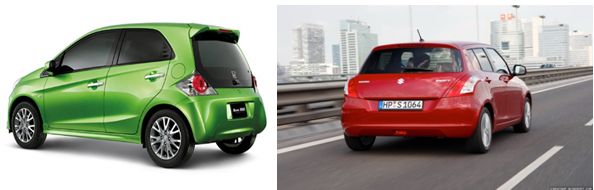
Honda Brio body is a mix of smart and intelligent craftsmanship with beautiful aerodynamic styling. Front fascia boasts of pearl shaped head lamps, chromed grill having company’s logo neatly tucked and large lower grill carrying fog lamps bestow the little car with head turning looks. Body coloured bumpers, side mirrors and door handles along with rear spoiler contribute to the overall next generation styling of this brilliant Brio.
Maruti Suzuki Swift 2011 carries most of looks from its predecessor model but now it’s more refreshing with bigger head and tail lamps. The wheelbase has been increased which has imparted amazing style to this sporty car. Refined front and rear bumpers bless this new Swift with alluring looks. This new hatchback has reduced height but is wider and lengthier than its predecessor model.
On the looks front, it is quite difficult to choose which one since both cars has their own identity with Swift having more road presence while Brio being a head turner. It’s a tie.
Interiors

 Brio’s interiors are expected to be perfect for five occupants with exotic interior trims employed. The refinements are sure to evoke your inner instinct to drive with pleasure. However the compact body design indicates that the car will have limited space. Interior features like power steering, graceful dashing board, armrests, gear Knob, body coloured mirrors, integrated audio system including USB and powerful AC sets aside its competitors.


Contrarily, Maruti Suzuki Swift 2011 is one of the most spacious cars in its segment with enough head and leg room for all passengers. Multifunctional new steering wheel and instrument cluster is now more refreshing than the 2010 Swift with black and silver finish, both contributing to the plushness of the cabin. Comfortable leather seats with foldable rear seat option, AC with climate control, power windows, etc are some of the features of this new scintillating car.
Maruti Suzuki Swift’s Interiors are a far cry from Honda Brio.
Engine, Specification and Performance
Honda Brio will be fitted with 1198 cc, i-VTEC, petrol engine that will have efficiency to churn maximum power of 89 bhp at 6200 rpm and peak torque of 110 Nm at 4800 rpm. The engine of the car would be mated with a 5 speed manual transmission. Honda Brio is expected to cross the speed slot of 0 to 100 kmph in mere 16 seconds with the top speed being 158 kmph. The car offers decent mileage 14 kmpl in city conditions while 19 kmpl on highways.
Mesmerizing Maruti Suzuki Swift 2011 is powered by 1298cc, 4 Cylinder, 16 valves petrol engine. This powerful engine is capable of producing maximum power of 87 bhp at 4000 rpm and a peak torque of 113 Nm at 4500 rpm. Linked with 5-speed manual gears, Swift races from 0 to 100 kmph in just 10 seconds and has a top speed of 160 kmph. As far as fuel efficiency is concerned, it delivers around 15 Kmpl in city while 18.5 Kmpl on highways.
Both the cars have almost similar engine performance with Brio getting slight edge but Swift soon catches it.
Bottom Line : Maruti Suzuki Swift is one amazing car and now it faces competition from the new stallion from Honda the Brio in terms of power and specs these two cars are neck to neck both the company’s have proven reliability to support them as well as the loyal customer base.Only time will tell who would be thee winner amongst thee two


Skoda Superb vs Honda Accord vs Volkswagen Passat

Skoda Superb vs Honda Accord vs Volkswagen Passat

In the automotive field, not many cars can claim to their throne of being the number 1 for quite a long time. However there are some exceptions like the Maruti Swift, Honda Accord and Honda City. No wonder how many competitors came through, these cars have always remained the hot favorites. Out of all these cars, the Honda City has maintained its lead the most. As the title suggests, this comparison is all about the executive class of cars. Not long ago, we had crowned the Skoda Superb as the new segment king however the time has come now to pit it against its blood relation, the Volkswagen Passat. The 2011 Volkswagen Passat in India is a car which like the Superb, unanimously impressed one and all at Indiandrives. So it was prudent enough that we take the Skoda’s old competitor the Accord and the newest one to stake a claim at the throne, the Volkswagen Passat. Since the Passat is currently offered with only a diesel motor while the Honda is offered only in crude oil versions, we decided to take the top end 1.8 TSI motor of the Skoda along with the 2.0 liter TDI of the Passat and the 2.4 liter variant of the Accord.

 All the three cars here wouldn’t win any beauty pageants as they all have their quirkiness in the design factor. The newest of the lot doesn’t look the newest while the oldest of the lot, the Skoda Superb doesn’t look as old. Starting off with the Skoda, it is more than evident that the Skoda has got a design theme which is far different than the approach taken by Volkswagen for its Passat. While the Skoda features some curves, the Passat is mostly devoid of them. It is more of arrow straight edges and a crisp design theme, more in the ballpark of the newly launched Vento. Personally I don’t like the new Passat that much. Its however the Honda Accord which would take the piece of cake as far as the styling is concerned. Not only does it boast of much better crisper and tauter lines, it also gets the much needed flashy styling that buyers in this segment so desperately seek for. For the more subtler ones who prefer to hide their identity, the German twins would suffice. Personally, the Indiandrives team prefers the Honda Accord in India’s styling. So on the design field, it is the Honda Accord with its low slung styling and ready to attack stance that wins the design parameter stakes. Next up would be the Volkswagen Passat and finishing at the bottom of the heap is the Skoda Superb in India.
Interiors of all the three cars is very inviting though I have reiterated that the Volkswagen’s all black interiors don’t look very cosy at the outset. But as they say, “you cannot judge a book by its cover” stands true for the Volkswagen Passat. All of the Indiandrives staffers said that the Passat’s seats are very comfortable, belying the initial notions of this not being very comfortable. The front seats may not have as much space as say the Skoda Superb but still the few thoughtful touches like the small fans besides the seats more than make up for it. The features list in this German is extensive. There is parallel parking, sunroof, reverse parking sensors, auto head lamps, fog lamps with cornering function and much more. The Skoda in the meanwhile, also on the same platform, boasts of better space utilization. I am not sure but it seems that Skoda always goes one up on the Volkswagen as far as space utilization is concerned. Not only the use of lighter upholstery makes the Skoda look more spacious, it also feels more spacious. That’s an amazing thing I would say. The Honda Accord isn’t far off the mark as far as front seat space is concerned. The Honda Accord has better cushioning as well. But then it lacks on the features front, something which Honda isn’t quite known for. But front seats usually don’t matter to people buying into this segment and its the rear ones which usually matter. All the three cars here don’t disappoint on this count. The Honda Accord sits lower than the others in this comparison. Ingress and egress is a bit of a problem in here, Especially for those wearing mini skirts. The doors don’t open as wide for the Passat as they do for the Skoda. So overall, the Skoda makes for a good chauffer driven car especially where the attention to detail is concerned. It has got AC vents in the B-pillars, something which is yet to be seen in the other two. The rear seat passenger’s armrest folds completely to reveal a passage through to the boot. Fitting in long objects in the boot like a architectural design or otherwise is now an easy task. Boot space for all the three is more or less the same and no complaints on that part. The Volkswagen Passat doesn’t break any new grounds except for the availability of the parallel parking system. The Skoda Superb still reigns supreme in this ground as far as chauffer driven cars are concerned. Now would you be really concerned of the parallel parking system if you have hired a chauffer? I don’t think so. So its the Skoda Superb followed by the Volkswagen Passat and then the Honda Accord.
 A chauffer driven personality would care more about the ride quality of his car rather than the way it attacks a corner. I always feel that both of them go hand in hand or rather wheel in wheel or shock absorber in shock absorber, whichever way you take it. Not only does the car have to take its owner in supreme comfort but also has to ensure that he doesn’t throw up his breakfast while going around a corner. The Honda Accord ensures that the latter is taken care of. It is more of a corner carving car. On the ride quality front, it acquits itself well however the sharper bumps do catch it off guard and it feels a bit fidgety while crossing all those potholes. NVH in the Honda is nicely tuned and it is once past the 4500 rpm mark that this car displays a buzziness which is similar to that of angry bees bumbling along. The  Skoda Superb in the meanwhile is all the more about the cosseting ride quality. It is sprung a bit more stiffly than the Accord and hence can attacks potholes in a much better fashion. The Accord suffers from the time honored problem of Honda cars looking as if they have one spring less in their rear wheels. Don’t believe me, check out any fully loaded Honda car and you would notice that it feels as if the car does lack a suspension component. Coming back to the Skoda, the ride is all taken care off and even the car feels quite at home in a corner. What it however displays a willingness to go around corners. It has to be goaded into one. The steering wheel however feels more at home on straight stretches rather than corners. It has more feedback to deliver than the light lifeless steering wheel of the Accord though. NVH however is a bit more nicely damped than the Honda. The new kid on the block, the 2011 Volkswagen Passat however manages to deliver a pliant ride quality as also stellar handling. It has got the handling prowess of the Honda and the ride quality of the Skoda. So much so that the ads running nowadays on the telly would definitely convince anyone that the car is NVH free and I can personally vouch for it. You would barely hear the horn of a car passing by. The steering wheel of the car is typical Volkswagen however since this unit is an electrical one, it dials in more feedback than the Skoda. The Passat also feels a better car to drive thanks to all the driver aids helping things to be on the better side.
Thankfully, the engines on all the three cars are different. While the Honda engine is typically Honda, making its peak power at the top of the rev range, the Skoda and Volkswagen have better driveability lower down in the rev range. While I wouldn’t be elaborating on the power rating and engine options that these cars carry (since they have been already covered in various articles on www.indiandrives.com), I would rather concentrate more on the driveability and user friendly quotient. First goes the Honda Accord. The Accord feels a bit of laggard unless enthusiastically driven. The 5 speed auto gearbox takes a bit longer to realize whats going on. It even down shifts with a bit of  reluctance. However, as discussed earlier, once past the 4,500 rpm mark, the engine pulls cleanly and well upto its 7000 rpm redline. For the Skoda, its a mix of usable power that it brings into the equation. Not only is the gearbox superb (no pun intended) in its execution, it also extracts proper power from the 1.8 liter motor, which is the smallest in this test. The Volkswagen Passat in the meanwhile has got a diesel motor which has got a host of BlueMotion technologies to help it eke better fuel efficiency and at the same time keep the emissions real low. The Passat is the most easiest car to drive amongst this lot. It makes power lower down the rev range and it being a diesel feels all the more driveable. Diesels usually aren’t that free revving however this Passat engine does rev freely and is an effective highway long distance cruising machine.
What is all the speed in this world if one cannot control it and for this very reason, all these cars are equipped with powerful discs both at the front and rear. They have got ABS, EBD and many more electronic goodies which reign in all the power and bring the cars to a safe halt. While the Honda Accord takes a bit longer to come to a halt, it is the Passat which takes the shortest time and distance. Safety is also high tech in all these cars, according to Indian standards. The Passat just edges past the others with its usable safety features dragnet with the Superb coming in next and the Accord finishing at the bottom of the heap. The Accord basically has a fragile body frame than the others in this comparison, which feel build like a tank. Fuel efficiency recorded on the Passat is an impressive 15.3 kmpl overall. The Honda Accord returned about 11.2 kmpl overall while the Skoda Superb gave 12.3 kmpl. Clearly the Passat with its diesel engine has an edge over its petrol counterparts.

The 2011 Volkswagen Passat in India wins this round purely on the basis of its superior engine technology, safety features, thought for the environment and also the fuel efficiency.
Overall, out of all these cars, the Honda Accord in India would be discounted first on the reasons that it needs an upgrade badly to its engine and powertrain. Only some cosmetic changes wouldn’t cut the mustard in these days of competition. Plus the biggest disadvantage for the Honda is its lack of diesel engine. Honda has plans to bring in a diesel engine in the latter part of 2011 however we aren’t too optimistic about it considering the recent earthquakes which hit Japan. Finally the Skoda Superb seems to have been displaced from its number one perch. No longer is it the segment leader. But this is just by a small margin and that small margin happens to be with the number of safety features that the Volkswagen offers. It is much simpler car to live with as well. If the price is brought into the equation, all these cars are priced more or less similarly. The Honda Accord price in India is Rs 22.4 lakhs while the Skoda Superb price in India is Rs 22.38 lakhs. The Volkswagen Passat price in India is Rs 22.78 lakhs. All these prices are ex-show room prices, Mumbai. So the new king of the pack is the 2011 Volkswagen Passat. Go for it.

Fortuner vs Endeavour vs Pajero


Toyota Fortuner vs Ford Endeavour vs Mitsubishi Pajero
 This comparison should have been done long back when the Toyota Fortuner set its foot on the Indian soil however due to some unforeseen oversight, this was never done. I firmly believe that its never too late to compare the cars or in this case hardcore SUVs. Most of the times, when we see a SUV in our rear view mirrors, we involuntarily allow it to go ahead. I believe it has got to do with this notion that if we don’t give it the right of the road, then probably the SUV may end up tailgating us or worse hammer away our small hatchback to pieces. Such is the mentality. While US or Europe may boast of the big bad Hummers (they are no longer in mass production now), we at India have to be content with the likes of the Mercedes GL or Land Rovers. Am I missing something here? Oh yes, the protagonists of this plot, the Toyota Fortuner in India and the Ford Endeavour in India. Both these SUVs are the best in their class and provide the much needed “shadow effect” that SUVs this size are supposed to. and now it was the time for the Fortuner to be stacked against the mighty Endeavour and also the long forgotten but very capable Mitsubishi Pajero in India. The latter has been the favorite of film stars and personalities alike from the time, the Fortuner and the Endeavour were in conceptualization stages.
 Looks
In this department the more the intimidating, the more the prettier. Out here, the Fortuner feels the more intimidating with its raised on stilts look far more extendable than the car like one of the Endeavour. The air intake scoop on the bonnet of the Fortuner signifies its sportiness whereas the Endeavour gets a plain unit and a brick shaped bonnet. While the Ford Endeavour in India is more about looking like a bread box, the Toyota Fortuner in India is the more rounded design. The bonnet scoop on the Pajero looks a bit ancient like the rest of the car and it is as brick like as the Ford Endeavour. The Mitsubishi Pajero in India however has the dual tone color which the other lack and for some it may seem gawdy but for me, it looked fantastic. Mitsubishi have chosen to take this path since they firmly believe that this would mask the ageing design of this SUV. The wheel size also differs in each SUV here. While the Toyota Fortuner has got 17 inchers, the Ford Endeavour and the Mitsubishi Pajero are available with 16 inch and 15 inch tyres respectively. The Pajero’s dated looks are evident even from the rear side with no LED gimmick or even clear lens thing. The Ford Endeavour’s Christmas tree tail lamps also look a bit old however they are far better than the one in the Pajero. The Toyota Fortuner has a more car like split tail lamp configuration. However it seems that the Toyota designers actually forgot the rear end of this car and had exhausted all their resources on the front end of the car.
Based on the looks front, it would be the Toyota Fortuner which overall comes out in trumps. Next up would be the Mitsubishi Pajero and then the Ford Endeavour.
 Interiors
Not only does the Pajero look dated (with an old world charm), it also feels the same from inside. The meter dials wouldn’t look out of place in a 1970s BMW car with its all analogue instrument cluster. The 4 spoked steering wheel also looks ancient and more truck like. Liberal use of fake wood has been done to spruce up the cabin which otherwise looks Spartan. However the high set seats are comfortable to say the least. However the middle row and third row seat passengers would have a hard time with the lack of leg space. 427 liters of boot space is more than enough for a few trips to the malls. The Ford Endeavour in India has got a huge and spacious cabin. Its cabin doesn’t look ancient like the one in the Pajero. The 4 spokes in the steering wheel are nicely spaced out. The use of black plastic for the upper half of the dashboard and beige for the lower part does impart a luxury feel. There is a touch screen audio system along with a navigation system. Space in the front is more than ample and the middle row of seat is also comfortable. The rearmost seats however are a disappointment but not much as in the league of the Mitsubishi Pajero in India. Boot space is less than that of the Pajero at 363 liters. The Toyota Fortuner in India has got smaller meter dials than the Endeavour however these are legible as well. The steering wheel is a 4 spoke unit and the only one in this comparison to come with steering mounted audio controls. The use of beige lightens up the cabin as it seems a bit claustrophobic due to the high set seats and the less glass area. In typical Toyota fashion, wood trim is used on the door pads and for placing the power goodie controls. But then the Innova which is available for a good Rs 10 lakhs less has got similar interiors. Comfort is the other name which the Fortuner’s middle row is known by. It is the most comfortable of the threesome (don’t get any wrong ideas) here. The rear in the meanwhile can hold people south of 6 feet only. Boot space of 960 liters can be achieved via flipping the rear seats. Automatic climate control is part of the package for both the Fortuner and the Endeavour.
In this section, it is the Ford Endeavour which wins purely due to its equipment levels and the amount of space and comfort that it provides. The Fortuner follows it and needless to say, the Pajero is the last one out.


 Ride and Handling
The Toyota Fortuner is based on the IMV platform on which even the Innova is based upon. The suspension of the Toyota is a bit on the harder side and hence it smothers everything in its path. However this is achieved when the SUV is fully loaded. If its just the driver and the vehicle, then under harsh braking, the car tends to pogo a bit. The handling is okay, mainly due to the permanent all wheel drive system coming into picture. However going around corners isn’t its forte as waddling around in slush is. Presence of parking sensors makes it easy to pilot this SUV around in town. The steering wheel however could have done with a lot more feedback. The Ford Endeavour has a top heavy experience going for it while the entire SUV tends to shrink around the driver when attacking a corner. The ride quality with leaf springs ain’t too bad either but then the Toyota feels a little more compliant over bumps. The Pajero is a front wheel driven vehicle but has a wide array of off-roading aids going for it. Low speed ride quality is the Pajero’s forte while higher speed sees the Pajero getting a bit nervous when it comes in contact with bumps. The Pajero is more of a mountain goat and has got limited slip differential locks, hill descent control and a 4×4 mode along with low ratio ensures that the Pajero reaches a certain place where the Fortuner and Endeavour can only dream about. As far as off-roading is concerned, there is no holding a candle to the Pajero but then it’s a tough fight between the Endeavour and the Toyota for the second and third spot. The 4×4 option in both vehicles does work well however the Toyota’s taller ground clearance and a bit more of engine power at lower revs ensure that it comes out on top of the Endeavour. As far as NVH is concerned, the Pajero is the one which is the most vocal of the lot followed by the Fortuner and then the Endeavour.
Overall, this is the territory of the Mitsubishi Pajero followed by the Endeavour and then the Fortuner. If its was off-roading, then the Pajero, Fortuner and the Endeavour would be picked up for their abilities.
Engine, performance and fuel efficiency
The Mitsubishi Pajero in India has got the latest engine upgrade. The ever tightening emissions norms mean that the 2.8L 4 cylinder turbocharged intercooled diesel engine now makes 108 Bhp of power and an even lower 260 Nm of torque. It is aligned to a 5 speed manual with long throws. Needless to say, the Pajero feels the sluggish of the lot, now moreso with the reduced power output and torque. The 0-100 kmph run was completed in a leisurely 17.8 seconds with the SUV topping out on a max speed of 156 kmph. Unfortunately rear discs are still missing and hence the Pajero recorded the highest braking distance when the brakes were slammed at a speed of 100 kmph. The SUV may be old school however Mitsubishi have kitted it with modern braking aids like traction control, EBD and ABS. Airbags are also a standard feature. The Toyota Fortuner in India features the most powerful engine in this lot. The 3.0 liter turbocharged intercooled engine makes 170 Bhp of power and 343 Nm of torque. A 5 speed manual gearbox which is similar to the Pajero’s handles transmission duties. This gearbox has a similar nature like that of the Pajero. The Fortuner breaches the 0-100 kmph mark in 12.9 seconds while the top speed is also higher at 176 kmph. The Fortuner being the priciest of the lot still makes do with rear drum brakes. Like the Pajero, the Fortuner is also blessed with various braking aids and safety supports. The 3.0 liter DOHC turbocharged diesel unit of the Ford Endeavour in India boasts of 156 Bhp of power and 380 Nm of gut wrenching torque. A 5 speed manual transmission handles the chores of gear shifting. It is a sweet shifting unit unlike the others. The 0-100 kmph mark however was dispatched in 15.2 seconds, much higher than the Fortuner’s mark. Top speed is also less than the Fortuner at 166 kmph. Brakes in this leviathan are fantastic and being all discs have better halting powers. The usual safety dragnets are present.
As far as fuel efficiency is concerned, the Pajero with its BS4 motor returns an overall 12.3 kmpl. The Fortuner returns 11.8 kmpl overall and the Endeavour turns in 12.4 kmpl. The Endeavour is a wee bit fuel efficient than the others here.
It is the Fortuner’s engine which shows an eagerness to rev more than the others and keep the driver delighted. Moreover, its fuel efficiency isn’t affected by a great extent due to this revving nature. However as far as the features list is concerned, it is the Endeavour which comes out on tops.
Final Verdict
One thing is for sure in this comparison. Mitsubishi need to up their act or else, they would be in great trouble. Conforming to BS4 norms mean that they have lost out on their power rights bragging (which anyways was lower than the rest of the cars in this brigade). But it stands true to its roots and that is off-roading. If you need a SUV for everyday roaming as also for off-roading, then look no further than the Pajero. However if you are inclined to use it more for on-road use than for off-road, then it’s the Ford Endeavour for you. Its got tonnes of equipment and has a manual and automatic gearbox option (the only one in this comparison). Road presence is tremendous in this SUV as well. It has got luxurious interiors as well. The downsides are basically none and this enhances its appeal. It can be even brought in 2 wheel drive mode. The Toyota Fortuner in India is one hell of a SUV. It not only has tonnes of road presence but also oodles of space inside. However its Innova like interiors would make one to detract from the luxury feel. If you are willing to forgive its interiors, then this is the SUV for you. The Ford Endeavour trumps the Toyota Fortuner by a whisker here. The Toyota Fortuner price in Indiastarts from Rs 19.88 lakhs and goes all the way to Rs 22.1 lakhs. The Mitsubishi Pajero price in India is Rs 20.1 lakhs whereas the Ford Endeavour price in India is the least costliest of all with its price starting from Rs 16,3889 and closing at Rs 19 lakhs. All these prices are ex-show room, Delhi. The Endeavour it is then, all the way to go. Lest I forget, the Toyota Fortuner’s long waiting period would have you flummoxed as well.

SKODA FABIA VS VOLKSWAGEN POLO

Comparison OF Volkswagen Polo Highline and Skoda Fabia Elegance Specifications


The Volkswagen group has hit the jackpot in India with its recently launched premium hatchback Polo.
The company received an overwhelming response and is facing delivery backlogs.
Volkswagen group's sister company Skoda too has a premium hatchback, Fabia, in the Indian market.
But the Skoda Fabia did not manage to get the same response as the Volkswagen Polo. This leads to a comparison of the two cars to find out what are their strengths and weaknesses.
 Engine capacity
Skoda Fabia comes in both diesel and petrol engine options. The petrol engine is a three-cylinder 1.2 HTP engine with a power output of 70bhp at 5400rpm and max torque of 108 Nm at 3000rpm.
The diesel engine has a three-cylinder 1.4 turbo diesel with power output of 51 kW with a max torque of 155Nm at 1600-2800rpm.
On the other hand, the Volkswagen Polo comes in both petrol and diesel options. The three-cylinder 1.2L, 1198cc, petrol engine offers 74 BHP at 5,400 rpm and 110Nm of torque at 3,750 rpm.
The 1.2L 3-cylinder diesel offers 74 BHP at 4,200 rpm and 180Nm of torque 2,000 rpm.
 Features
You have the option of buying the Volkswagen Polo in highline, comfortline and trendline trims.
The cars has some unique features that include storage compartment in front doors for 1.5 litre bottles, sunglass storage inside glove box, folding rear seat backrests and the two-tone dashboard.
Polo also offers remote keyless central locking that includes remote window up/down on the highline, which is unique in the segment.
Talking about the standard features - the tilt and telescopic steering, green-tinted heat-blocking glass, body coloured bumpers, halogen headlights and galvanised body with 6 years anti corrosion warranty.
 Skoda Fabia has impressive dual tone design with multi-textured seat fabrics.
The instrument panel displays current time, outdoor temperature, instantaneous fuel consumption, average fuel consumption, distance travelled, time driven and average speed range.
Some other key features include a remote keyless entry for one-touch lock and unlock, electronically adjustable and heated outside rear view mirrors and front and rear power windows.
Skoda Fabia has a chassis that has a sophisticated front McPherson strut suspension along with a strong lower A-arm and non-independent rear suspension designed for Indian roads.
 Fuel efficiency
Skoda Fabia's petrol engine delivers approximately 14.7 km/litre on the highway and 11.6 kmpl in the city.
While the1.4 turbo diesel engine gives an amazing fuel efficiency of 14.1 km/litre in the city and 18.5 km/litre on the highway.
The Volkswagen Polo petrol offers a mileage of about 12 kmpl in the city and 16 kmpl on the highway while the diesel version offers about 13.5 kmpl in the city and 17.5 kmpl on the highway.

Price factor
The Volkswagen Polo is available between Rs 434,000 and Rs 700,000, and Skoda Fabia comes for Rs 502,037 to Rs 784,202 (prices ex-showroom, Delhi).
Having analysed both the cars one can conclude that both Polo and Fabia have some of the best features in the segment.
Same can be said about their performance and fuel efficiency. But the questions then arise that why Fabia lacks the popularity that Polo is getting.
The only factor that seems to be causing this is the price. The price-sensitive nature of Indian buyers votes in favour of Polo that costs a little less than Fabia.

Specifications
Volkswagen Polo
Skoda Fabia
Engine
Type
Inline 3 cylinder, diesel
Engine Capacity
1199 cc
1199 cc
Valve Train
3 cylinder, 4 valves, SOHC
Max Power
75 PS@5400 rpm
75 PS@5400 rpm
Max Torque
180Nm@2000 rpm
180 Nm@2000 rpm
0-100 kmph
16.16 secs
16.90 secs
Underpinnings
Suspension (front)
MacPherson Strut with stabilizer bar
MacPherson strut with torsion stabilizer and lower triangular links.
Suspension (rear)
Semi-independent trailing arm
Compound link crank-axle
Brakes (Front / Rear)
Ventilated Disc / Drum
Ventilated Disc / Drums
Tires
185/60 R15
185/60 R14
Top Speed
164.8 kmph
163.4 kmph
Braking (100-0 kmph)
54.3m / 3.57s
55.79m / 3.81s
Fuel Efficiency
City
15.8 kmpl
14.2 kmpl
Highway
22.2 kmpl
19.2 kmpl
Overall
22.1 kmpl
21.0 kmpl
General Data
Weight
1145 kgs
1152 kgs
Wheelbase
2456 mm
2465 mm
Height
1453 mm
1850 mm
Length
3970 mm
4000 mm
Width
1682 mm
1642 mm
Price (ex-Delhi)
Rs. 8.98 Lakhs
Rs. 8.61 Lakhs